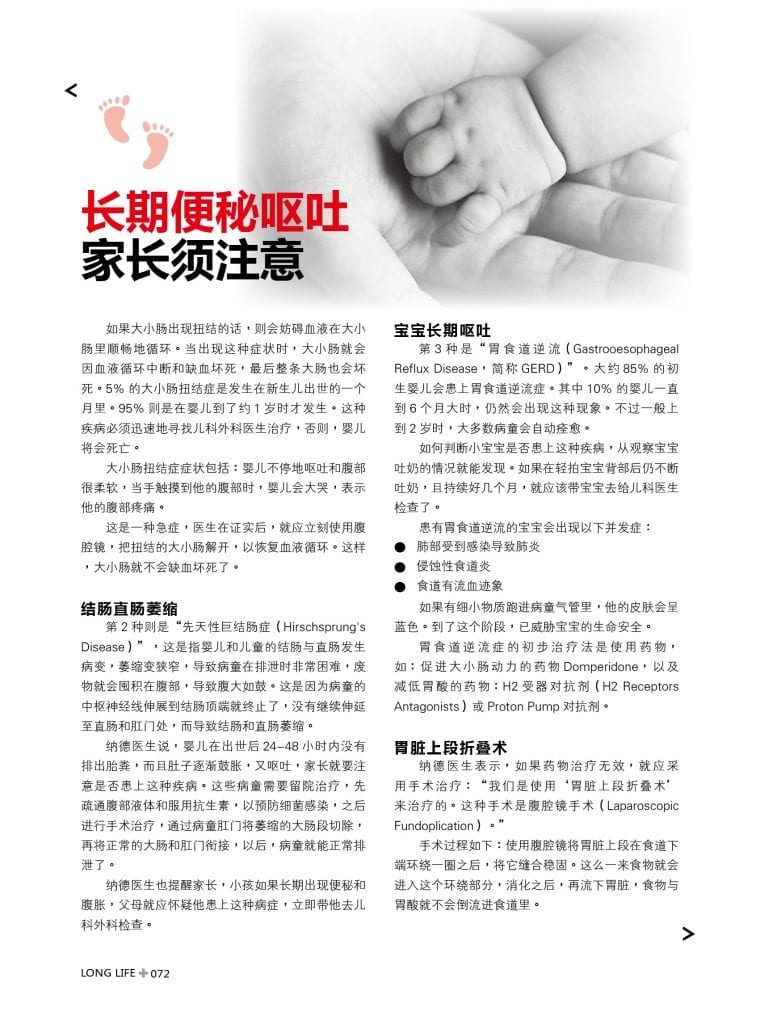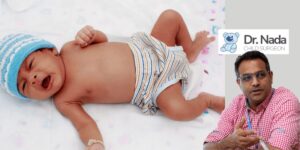
If the intestines are twisted or kinked, it will prevent the blood from circulating smoothly in the large and small intestines. This condition is called Intestinal Malrotation. When this symptom occurs, the large and small intestines will die due to low blood supply and the entire large intestine will also be necrotic. The disease must be quickly sought after by a pediatric surgeon, otherwise the child will have a serious and life-threatening complication.
Symptoms of intestinal malrotation include:
- Continuos crying
- A swollen abdomen that is tender to touch.
This is an emergency. After the doctor confirms, he should
immediately use the laparoscope to untie the large and small intestines to
restore blood circulation. Thus, the large and small intestines will not
be ischemic and necrotic
Colorectal atrophy
The second cause is “Hirschsprung’s Disease”, which
refers to the lesions in the colon and rectum of infants and children. The
atrophy and stenosis cause the sick child to have difficulty to poop, and the
waste will accumulate in the abdominal area, causing the belly to swell like a
balloon. This is because of the absence of particular nerve cells. The
middle sacral nerve line of the sick child extends to the tip of the colon and does
not continue to extend to the rectum and anus, leading to atrophy of the colon
and rectum.
Dr. Nada said if the baby did not pass the first stool within 24-48 hours after birth, and the stomach gradually swelled. These children need to stay in the hospital for treatment, the first procedure is to clear the abdominal fluid and take antibiotics to prevent bacterial infection, and then undergo surgery to remove the atrophic large intestine segment through the anus of the sick child, and then connect the normal large intestine and anus. Then the child will have a healthy bowel movement.
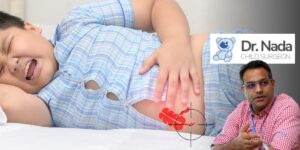
Dr. Nada also reminded parents that if a child has constipation
and bloating for a long time, parents should suspect that the child is
suffering from the disease and immediately take the child to a pediatric
surgeon for examination.
Baby continuous vomiting
The third type is “Gastroesophageal Reflux Disease
(GEBD)”. About 85% of newborn babies will develop gastroesophageal
reflux disease. This phenomenon can still occur when 10% of babies are up
to 6 months old. However, most children will recover automatically when
they reach 2 years old
Here’s how to judge whether a baby is suffering from this
disease.
- If your baby continues to spit milk or meal after you pat on your baby’s back and this goes on for several months, you should take your baby to check with your pediatrician.
A baby with gastroesophageal reflux will have the following complications:
- Infection of the lungs leads to pneumonia
- Invasive esophagitis
- Bleeding esophagus
If a small substance gets into the trachea of a sick child,
his skin will appear blue. At this stage, the baby’s life is not safe.
The initial treatment for gastroesophageal reflux disease is the
use of drugs such as Domperidone, a drug that promotes large and small
intestinal motility, and drugs that reduce stomach acid: H2 Receptors
Antagonists or Proton Pump.
Upper sinus surgery
Dr. Nada said that if drug treatment is not effective, then we
proceed to surgical treatment.
Surgical treatment: “We are using the “stomach upper segment surgery.” This type of surgery is Laparoscopic Fundoplication. The procedure is as follows: After laparoscopically wrapping the upper part of the stomach around the lower end of the esophagus, the awning is stabilized. As a result, the food will enter the surrounding part. After digestion, the stomach will flow down, and the food and stomach acid will not flow back into the esophagus.