
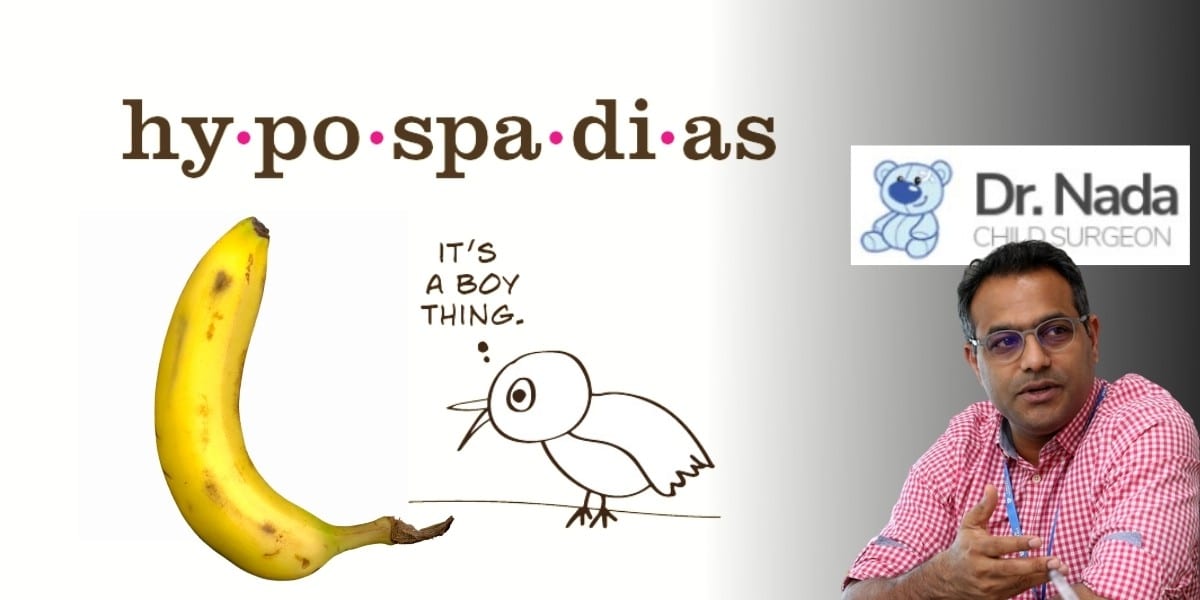
What is Hypospadias and how can it be treated in Malaysia?
Hypospadias is a birth abnormality of the penis.
Its occurrence is getting more frequent and now, it affects about 1 in 120 boys. In Malaysia, the incidence of the severe forms of Hypospadias is also increasing, to approximately 50% of all cases.
The function of the penis is to pass urine,
preferably in a standing position and secondly for sexual function when older.
For both of these, its ideal that the opening is at the tip of the penis and
that the penis is straight and not bent.
With Hypospadias, the urethra or water-pipe, connecting the bladder, where urine is stored, to the penis, is found to end in an abnormal position, not at the tip of the penis. The urine can therefore come out in the wrong place.
The other significant feature of the
hypospadiac penis is a curvature, this is often due to the “bowstring” effect
where there is tight, inadequate tissue on the underside of the penis, making
the penis to bend.
The third feature is the hooded foreskin, where again there is an absence of foreskin on the underside giving an appearance of a “hood” of skin on the upper side of the penis.
There are different degrees of Hypospadias:
- The opening of the urethra (where the urine comes from) is not at the end of the penis but is somewhere else along the underside of penis (see the diagram below).
- The penis may be bent; this is called a chordee.
- The foreskin may be only at the
top of the penis (dorsal hood) and there may be none on the under surface.
- There is not a straight stream of
urine.

What problems does Hypospadias cause?
Hypospadias is usually detected at birth, However the very mild forms can be missed and not picked up for several years.
A good paediatric surgeon will take time to explain your child’s conditions so you understand the type of Hypospadias he has. The treatment will also depend on this.
Your son’s issues are mostly functional, as your boy may find it difficult to direct his urinary stream, and in later life, intercourse may be difficult if there is a bend of his penis.
However,
the issue could also be psychological, the appearance of his penis without
surgery or a poor cosmetic result following surgery may be upsetting.
Therefore,
the age for correction of hypospadias is now younger, starting at 6–12 months
of age so that by the age of 3 to 4 it is all sorted for him and he will not
have any memory of any stressful events.
How is Hypospadias treated?
Hypospadias is usually corrected by surgery, the end result being to:
- move
the opening to the tip of the penis- this will enable your child to urinate
standing up and with a straight stream of urine
- correct
the bend so that the penis is straight and make the penis look normal.
Surgery may be a single procedure or may
require 2 or more stages depending on the severity of your child’s hypospadias.
In most cases, there will be a tube or stent
to drain urine from the bladder so as to keep the wound dry to heal. The tube
also acts as a scaffold onto which the newly created water-pipe with his own
tissue will heal on. The stent and penis will be wrapped with a dressing and
usually both the dressing and stent is removed after a week.
You will be taught how to look after the tube
at home. Make sure you understand the instructions before you go
home. Ask for clarification if you are not sure.
CIRCUMCISION WARNING: It is NOT advisable for your child to be circumcised before surgery. The foreskin is likely to be used in the operation. His penis will look like a normal circumcised penis after hypospadias surgery.
Risks of Hypospadias Surgery
As with all surgery, there are some risks involved.
However, the benefits of surgery will outweigh the risks.
Some complications specific to Hypospadias surgery include:
- A side effect from some
catheters is bladder spasms. Medication is available to help stop the
spasms if they occur.
- There may be some
bleeding from the penis.
- The wound may not heal
well. Either part, or rarely all, of the wound could breakdown. Urine
may then leak out of the original hole. This is called a fistula.
- The new opening may narrow, which
makes it more difficult to pass urine. This is called a stricture.
- There may be incomplete correction of the bend.
WARNING: Therefore, surgery to correct hypospadias should be ONLY done by an experienced paediatric surgeon (a doctor who specialises in urinary-tract systems of the child).
If you are concerned about your child’s penis, please do make an appointment to see Dr Nada as soon as possible.
Originally published in Easily Sin Chew on 18-09-2018
in Mandarin. Click HERE.